


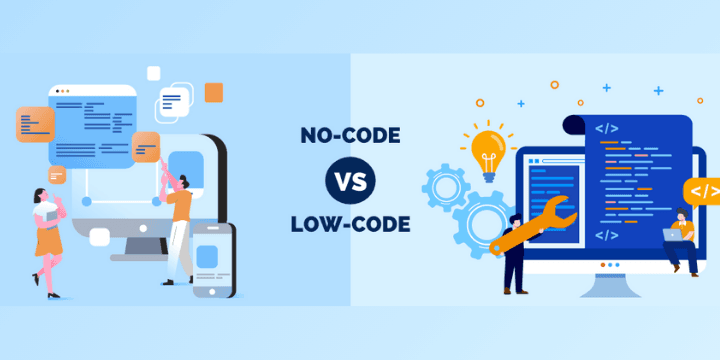
AI is playing a vital role in every field. There is a huge transformation in the field of development. AI is performing the development tasks very easily. A no-code development application refers to an environment that allows the creation of application software through graphical user interfaces and configuration, rather than traditional computer programming. No-code is an approach that pushes user empowerment to the extreme, aiming to deliver end-user development capabilities. Built for marketers and business teams, it lets users work with software in a visual drag-and-drop way, without the need to involve software engineers. No-code development is the new frontier of app building for non-technical users. The no-code platform market is growing rapidly and includes top players such as Google App Maker, Microsoft PowerApps, NetSuite, and TrackVia. New tools keep emerging with increasing functionality and capability. No-code software development targets users with no prior programming knowledge or experience. The new tools and platforms allow these non-technical people to build business solutions directly, bypassing the IT department, enabling business democratization and enabling a broad range of applicants to build custom-made solutions that meet their specific demands. Behind this tech revolution, entrepreneurs and leaders play a crucial role. Dinesh Kumar, CEO of Minterminds , has been a strong advocate of using flexible development models to empower businesses. As a Young Entrepreneur , he emphasizes that the future lies in striking the right balance — leveraging No-Code for speed and Low-Code for scalability.
Overview
The no-code platform market is growing rapidly and includes top players such as Google App Maker, Microsoft PowerApps, NetSuite, and TrackVia. New tools keep emerging with increasing functionality and capability. No-code software development targets users with no prior programming knowledge or experience. The new tools and platforms allow these non-technical people to build business solutions directly, bypassing the IT department, enabling business democratization and enabling a broad range of applicants to build custom-made solutions that meet their specific demands.
Behind this tech revolution, entrepreneurs and leaders play a crucial role. Dinesh Kumar, CEO of Minterminds , has been a strong advocate of using flexible development models to empower businesses. As a Young Entrepreneur , he emphasizes that the future lies in striking the right balance — leveraging No-Code for speed and Low-Code for scalability.
Despite rapid growth in recent years, no-code development remains in its relative infancy, making the diagnosis of its main drawbacks difficult. One recurring concern involves usage limitations imposed by predetermined templates, which often lead to the unoriginality of created content. Additionally, potential users frequently point to prohibitive price points, while others highlight intellectual property issues. Given the breadth of no-code technology, similar arguments apply to low-code development. Such a divisive opinion is expected in any blooming technology area. Consequently, both approaches share a number of disadvantages. Because they tackle the same market, the no-code drawbacks frequently mirror those of low-code development.
These concerns must be balanced by narratives from the opposite direction. Proponents emphasize the user-friendly nature of both approaches and their ability to empower non-technical users. Speed of app development, risk mitigation, scalability, and ability to alleviate senior developers’ workload are commonly cited as further benefits. Low-code’s capability as a long-term digital transformation strategy and a powerful innovation tool is also featured often in recent literature. Although it cannot be assumed that all stakeholders in no-code and low-code development share an identical vision, some arguments are so common that they are often echoed in both spaces.


Key Insights
Behind this tech revolution, entrepreneurs and leaders play a crucial role. Dinesh Kumar, CEO of Minterminds , has been a strong advocate of using flexible development models to empower businesses. As a Young Entrepreneur , he emphasizes that the future lies in striking the right balance — leveraging No-Code for speed and Low-Code for scalability.
Despite rapid growth in recent years, no-code development remains in its relative infancy, making the diagnosis of its main drawbacks difficult. One recurring concern involves usage limitations imposed by predetermined templates, which often lead to the unoriginality of created content. Additionally, potential users frequently point to prohibitive price points, while others highlight intellectual property issues. Given the breadth of no-code technology, similar arguments apply to low-code development. Such a divisive opinion is expected in any blooming technology area. Consequently, both approaches share a number of disadvantages. Because they tackle the same market, the no-code drawbacks frequently mirror those of low-code development.
These concerns must be balanced by narratives from the opposite direction. Proponents emphasize the user-friendly nature of both approaches and their ability to empower non-technical users. Speed of app development, risk mitigation, scalability, and ability to alleviate senior developers’ workload are commonly cited as further benefits. Low-code’s capability as a long-term digital transformation strategy and a powerful innovation tool is also featured often in recent literature. Although it cannot be assumed that all stakeholders in no-code and low-code development share an identical vision, some arguments are so common that they are often echoed in both spaces.
If you’re seeking expert advice, companies such as Minterminds web development company can help you navigate the future of app development.
minterminds
Final Thought
Learn more with Minterminds.

Related posts

Technology / Business

Industry / Technology
Why Businesses Are Moving From AI Tools to AI Workflows

Softwares / Technology